
Why is my tree leaning after a storm in Edison
A leaning tree after a storm in Edison NJ usually means root plate failure, a cracked trunk, or soft saturated soil. Here's how to tell which one you have.
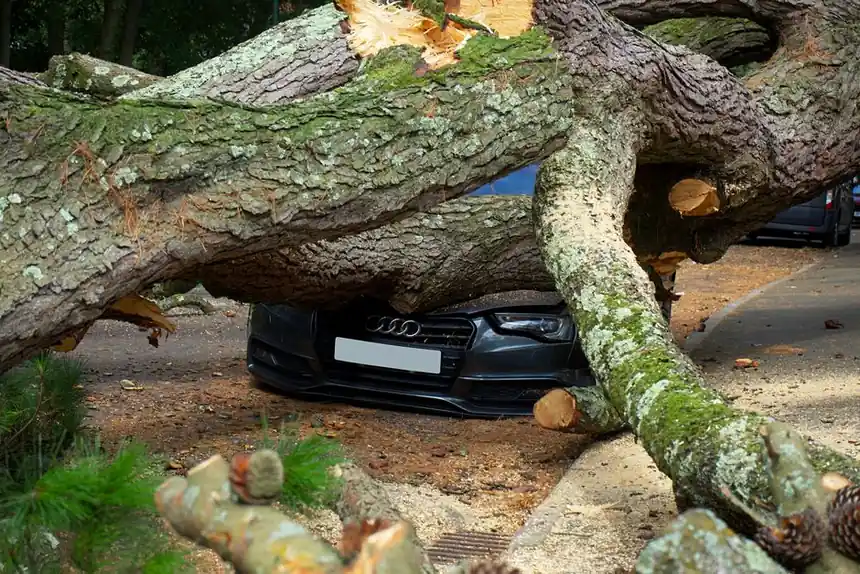
A tree leaning after a storm in Edison NJ almost always means the root plate has shifted, the trunk has cracked, or the soil around the base has gone soft enough that the tree can no longer hold itself upright. The lean itself is not the emergency - what is happening underground is. If the trunk is cracked, the root plate has lifted, or the tree is now within striking distance of your house, it needs to come down, not be propped back up.
We run calls like this across Edison and Metuchen every time a nor'easter rolls through. Below we break down the four causes, how to tell a cosmetic lean from a structural one, what you can safely do in the first hour, and when it is time to call us.
The short answer: what a leaning tree after a storm in Edison NJ usually means
A leaning tree after a storm in Edison NJ is a tree that has lost its vertical anchor - either because the roots tore loose on one side, the trunk split, or the ground beneath it liquefied. A tree leaning after storm damage is not the same as a tree that grew that way. Trees that have always leaned have thicker reaction wood on the tension side of the trunk and a full, undisturbed root flare. Trees that leaned last night have fresh cracks, exposed roots, and a mound of soil heaved up on the opposite side of the lean.
If you can see the root plate lifting out of the ground, the tree is already failing. It will keep going down, usually within hours to a few days, and the direction is not guaranteed to match the lean.
The four causes of a tree leaning after wind in Edison
When a tree leaning after wind in Edison shows up on our call sheet, it is nearly always one of these four things. Each one has a different fix and a different urgency level.
1. Root plate failure (the most common and the most dangerous)
Edison sits on a mix of clay-heavy glacial soil and older fill from the post-war building boom. That clay holds water. After a storm dumps two to four inches in a few hours, the top 12 to 18 inches of soil turns into something closer to pudding than ground. A 60-foot oak that has stood for 80 years suddenly has nothing to grip.
When the root plate fails, the whole tree pivots on the hinge roots on the far side. You will see a crescent-shaped mound of dirt and turf heaved up on the side opposite the lean. That mound is the tell. If it is there, the tree is a hazard, not a project.
2. Trunk or crotch cracks
A cracked trunk is a different animal. The roots are fine, the soil is fine, but the wood itself split - usually at a fork where two codominant leaders grew into each other. You may see a vertical split, a dark seam, or sap weeping out of a line on the trunk. Push on it gently with a gloved hand. If the two sides move independently, the tree is structurally finished.
3. Soil saturation without root failure
Not every lean is a failure. Sometimes the soil is just soft enough that the tree tips a few degrees and stops. A five-degree lean on a healthy tree with an intact root flare and no heaving is often cosmetic. It is also the hardest call to make from the ground, which is why we look at the root flare, the soil mound, and the canopy all at once.
4. Pre-existing decay you could not see
Most of the leaning trees we remove in Edison had a hollow or decayed core long before the storm. Mushrooms at the base, a cavity, carpenter ant frass, or a soft spot you can push a screwdriver into are all signs the tree was already compromised. The storm just finished the job.
How to tell if your leaning tree is an emergency
If any of the following are true, treat the tree as an emergency and keep people and pets out of the drop zone until a professional has looked at it. Do not wait for a second opinion from a neighbour.
- The root plate is visibly heaved up on one side.
- The trunk has a fresh crack, split, or seam.
- The lean is more than 15 degrees from vertical.
- The tree is within one tree-height of your house, garage, driveway, or a power line.
- You can hear creaking, popping, or wood cracking when the wind picks up.
- The canopy is suddenly thinner on the tension side, or you see fresh soil around the base.
If none of those apply and the tree simply looks a little off-plumb, you have time to get it assessed during normal hours. If even one applies, call us and stay clear. For homeowners dealing with a tree leaning near house, we treat those as same-day priority calls because the failure window is short.
Can a leaning tree be saved in Edison New Jersey?
Yes, a leaning tree can be saved in Edison New Jersey - but only when the root plate is intact, the trunk is sound, and the lean is small. That is a narrow window. In our experience, maybe one in five leaning trees we look at is a legitimate candidate for straightening or cabling. The rest come down.
The trees worth saving usually share three traits: the root flare is still buried, there is no soil heave, and the trunk has no visible crack or cavity. Even then, the fix is not to yank it upright with a truck. That snaps hinge roots and turns a survivable tree into a falling one. The correct approach is selective pruning to reduce the canopy load on the lean side, plus cabling or bracing if the tree is valuable enough to justify it.
For most homeowners, the honest math is this: a mature red oak that has already shifted its root plate is a liability, not an asset. Removing it and replanting with a species that handles wet clay better is the safer long-term call.
What to do if your tree is leaning in Edison: first 60 minutes
Here is the sequence we walk homeowners through on the phone before we arrive. None of it requires a chainsaw.
- Move people and pets out of the drop zone. The drop zone is roughly one and a half times the tree's height in every direction from the lean.
- Do not park under it. Move cars out of the driveway if the tree overhangs it.
- Take photos from a safe distance. Wide shots of the whole tree, close-ups of the base and any crack. We use these to triage the call.
- Do not cut anything. Cutting a leaning tree releases the tension holding it up and can drop it on you.
- Do not tie it to another tree or a truck. That is how people get hurt and how good trees get wrecked.
- Call a licensed tree service. We will tell you on the phone whether it can wait until morning or needs us now.
If the tree is touching a power line, stop at step one and call PSE&G first. Do not go near it, and do not let anyone else near it.
What to watch out for: common mistakes after a storm
Every storm we see the same four mistakes, and each one either costs the homeowner more money or puts someone in the hospital.
- Cutting the tree yourself. A leaning tree under tension is a loaded spring. The moment you cut the compression side, the trunk can kick back or roll in a direction you did not predict.
- Hiring the first truck that knocks on the door. Storm chasers follow the weather. Ask for proof of insurance and a New Jersey business address before anyone touches a saw.
- Assuming the lean is stable because it stopped moving. Root plate failures can sit for days and then go without warning, especially after more rain.
- Ignoring the second tree. If one tree in a cluster leaned, its neighbours took the same wind load. Have the whole row looked at, not just the obvious one.
One more: do not pile the debris at the curb and assume the town will take it. Edison and Metuchen both have specific rules about storm debris pickup, and a 40-foot trunk section is not going to disappear on its own. Our crews haul everything off-site.
When to call a professional
Call a professional the moment you see a heaved root plate, a cracked trunk, or a lean that puts the tree within reach of a structure. Those are not judgement calls - they are removals. We handle them with cranes, rigging, and a spotter, and we do it without dropping the tree on your roof.
We also handle the smaller jobs: a leaning ornamental that needs pruning to rebalance, a tree that needs cabling to stay upright, or a stump that has to come out after the trunk is gone. If you are not sure which category you are in, send us a photo. We will tell you straight.
Treeminator Tree Service is a licensed and insured New Jersey tree care company working out of Metuchen and covering Edison, Highland Park, and the surrounding Middlesex County towns. We give you a clear price before we start, and we clean the site before we leave.
Frequently Asked Questions
Why is my tree leaning after a storm in Edison NJ?
In Edison, the usual cause is root plate failure in saturated clay soil, followed by trunk cracks and pre-existing decay. If you see a mound of heaved soil on the opposite side of the lean, the roots have torn loose and the tree is failing.
Can a leaning tree be saved in Edison New Jersey?
Sometimes, but only if the root plate is intact, the trunk is sound, and the lean is under about 15 degrees. In our experience roughly one in five leaning trees is a real candidate for cabling or pruning. The rest should be removed.
Should I remove a leaning tree in Edison NJ?
Remove it if the root plate has heaved, the trunk is cracked, or the tree is within one tree-height of a structure. A tree that has already lost its anchor will keep moving, and the direction it falls is not guaranteed to match the lean.
Who do I call for a leaning tree in Edison?
Call a licensed and insured New Jersey tree service with storm experience. Treeminator Tree Service handles leaning and storm-damaged trees across Edison and Metuchen, and we can triage from photos before we arrive.
How much does it cost to remove a leaning tree in Edison NJ?
Typical 2026 pricing in this area runs $800 to $1,500 for a medium tree with clear access, and $2,000 to $5,000 or more for a large tree over a house that needs rigging or a crane. Emergency calls after a storm sit at the higher end.
Get help with Tree Service in Metuchen
If a tree is leaning on your Edison property right now, do not wait for it to finish falling. We will look at your photos, tell you what you are dealing with, and get a crew out if it cannot wait.
Call Treeminator Tree Service at +1 732-419-5574 for storm damage tree removal and emergency tree service across Edison, Metuchen, and Middlesex County.